Castrol / Digital for India / IBM
Make everyday business
easier to run.
Bringing distributors, dealers and business stakeholders together to turn field insight into concrete digital service concepts.

My documented roleFacilitator, distributor transactions group
Research foundation8 distributors & 10 dealers interviewed
Workshop2 days · 30 participants · 4 groups
01 / Business & human context
Strengthen loyalty by improving
the experience of daily work.
Castrol’s ambition was to improve customer experience and loyalty through a single destination for partners’ needs. For dealers and distributors, those needs extended across orders, stock, deliveries, payments, coupons, product knowledge and recognition.
The research described businesses working under competitive pressure, with limited space and considerable reliance on manual coordination. Dealers needed information to serve customers, while distributors needed visibility to plan deliveries, manage credit and support their sales teams.
The opportunity was to ground digital services in these everyday responsibilities, then bring the people involved into the conversation about what should change.
02 / Begin in the real environment
The shop floor changed
the shape of the problem.
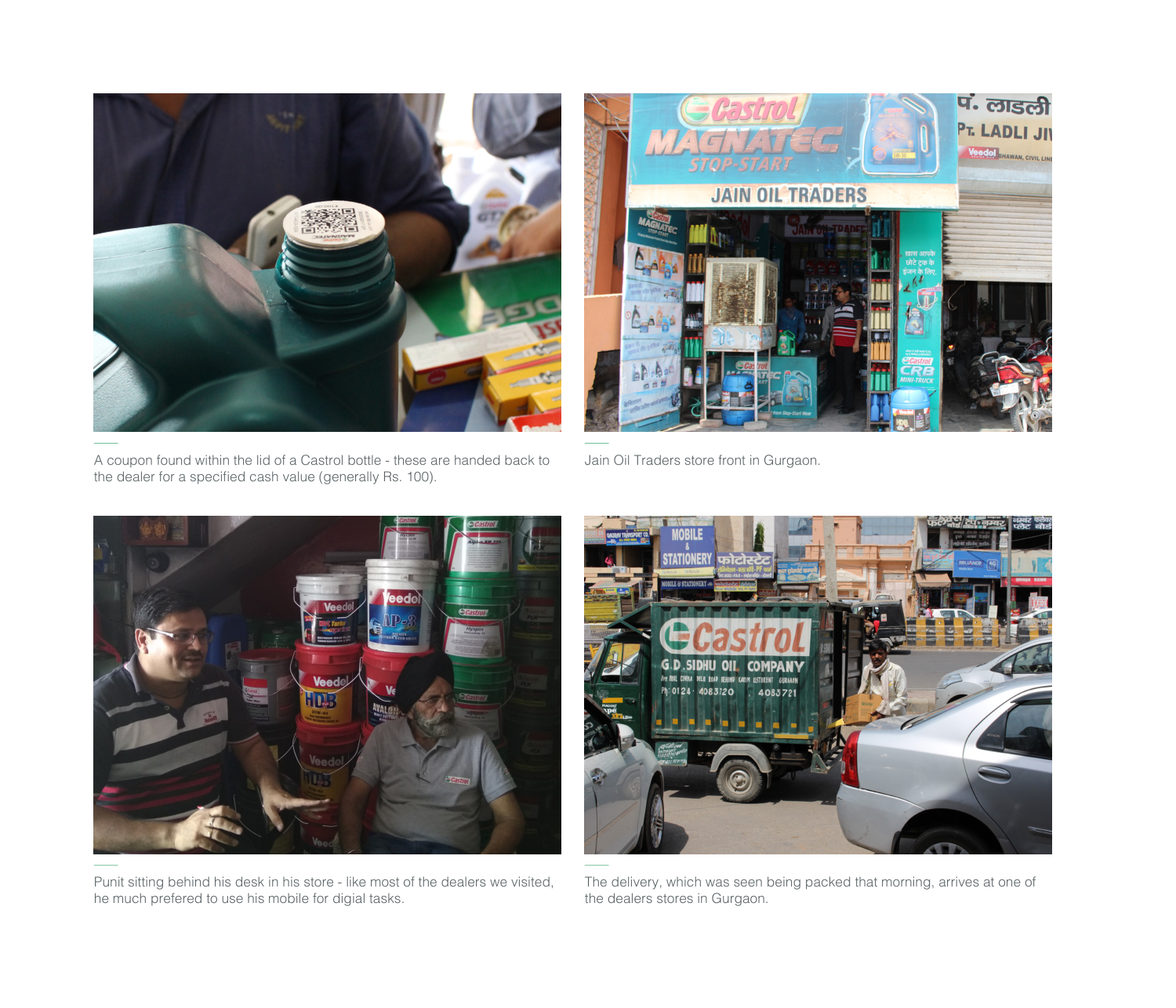
Before the workshop, the project team interviewed eight distributors and ten dealers. Site visits in the Delhi area and Mumbai put those conversations into context and helped shape initial personas and current-state journeys.
The playbook documents crowded stores, tightly packed warehouses, paper invoices and physical coupons. Several dealers preferred their phones for digital tasks. These observations gave the workshop specific conditions to consider rather than an abstract picture of a channel partner.
The persona synthesis also surfaced emotional and business concerns: pride in recognition, uncertainty about schemes, delayed payments, dependence on sales representatives and the effort of keeping business knowledge in one person’s head.
03 / My contribution
Facilitating the distributor
transactions group.
The playbook names me as the facilitator for Group 2. Its focus was the transactional relationship between distributors and Castrol: ordering stock, amending orders, receiving products, making payments, managing coupons and submitting claims.
Within that workshop, my facilitation role centred on helping the group work through a shared process: understand the persona, map the journey, identify friction and develop ideas in the user’s context. This is the contribution established by the materials; the research and all four prototypes represent the wider team’s work.
The leadership perspective
A useful workshop helps people move from their own functional viewpoint toward a shared understanding of the experience they are trying to improve.
04 / A structure for collective decisions
Build understanding.
Then make possibilities tangible.
Thirty participants, including end users and members of Castrol and IBM, worked in four groups over two days. The groups considered transactional and non-transactional journeys for dealers and distributors.
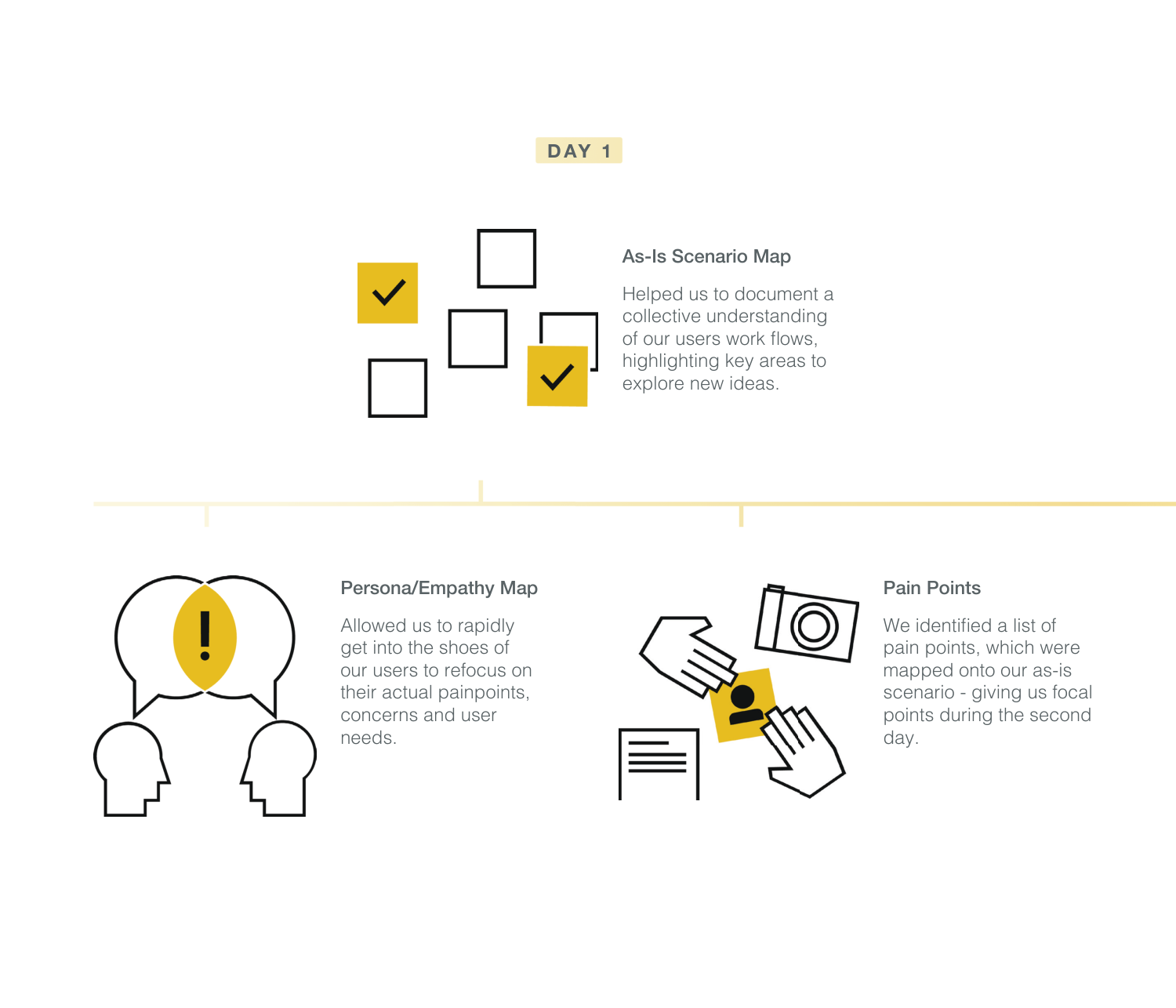
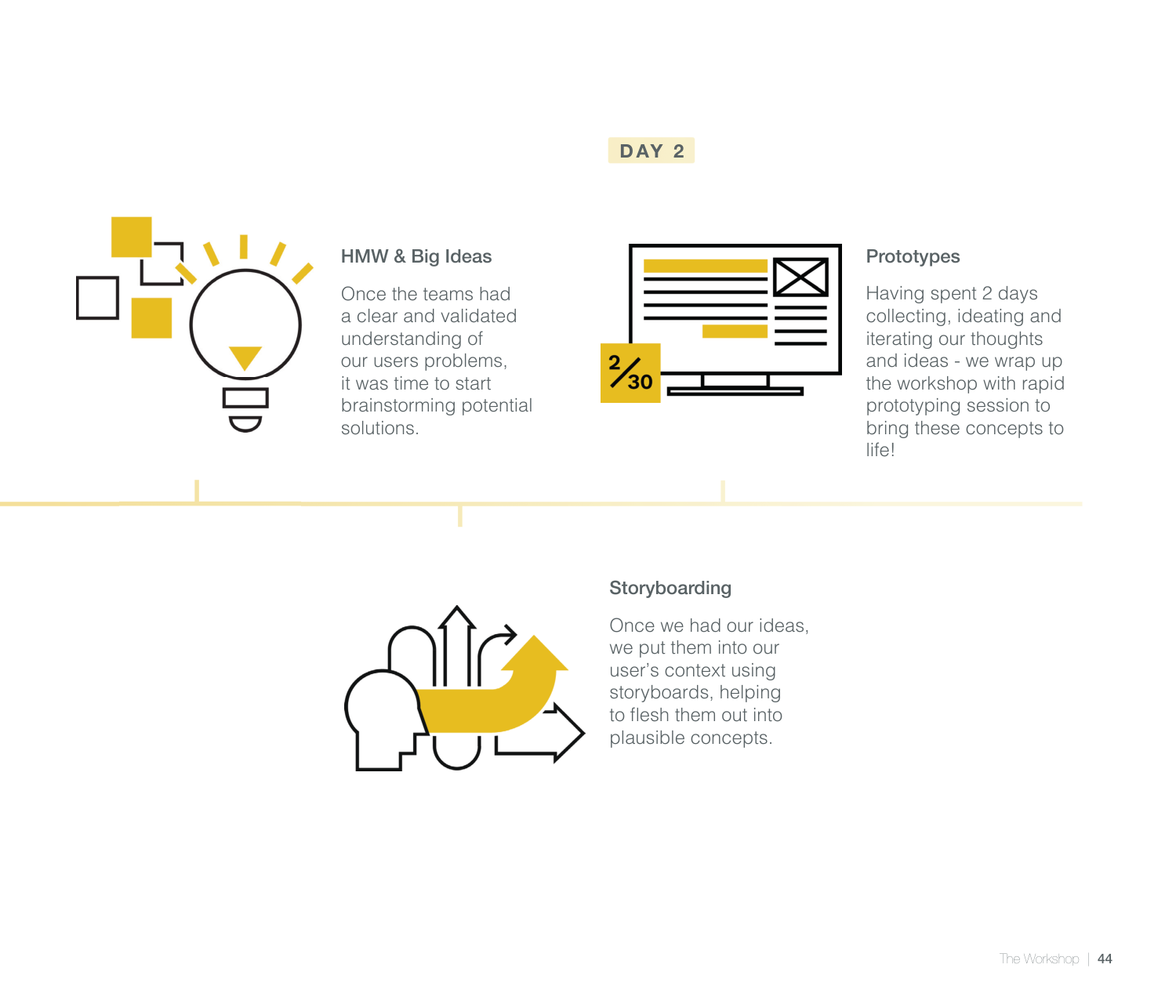
Day one used personas, empathy maps, current-state scenarios and pain points to establish the problem. Day two moved into opportunity questions, idea generation, storyboards and rapid prototypes.
The structure linked ideas back to the people and journeys they were intended to support. Storyboarding gave teams a way to examine a proposed experience before expressing it through screens.
05 / Sample UI · Fastlane
Make products, schemes
and support easier to find.
These Fastlane designs show four complementary views of the channel experience: discovering products, finding the sales representative, understanding schemes and evaluating a product before ordering.
The home screens bring category browsing together with either a product promotion or the representative. The schemes view makes progress and time remaining visible; the product page combines specifications, pricing and a purchase incentive.
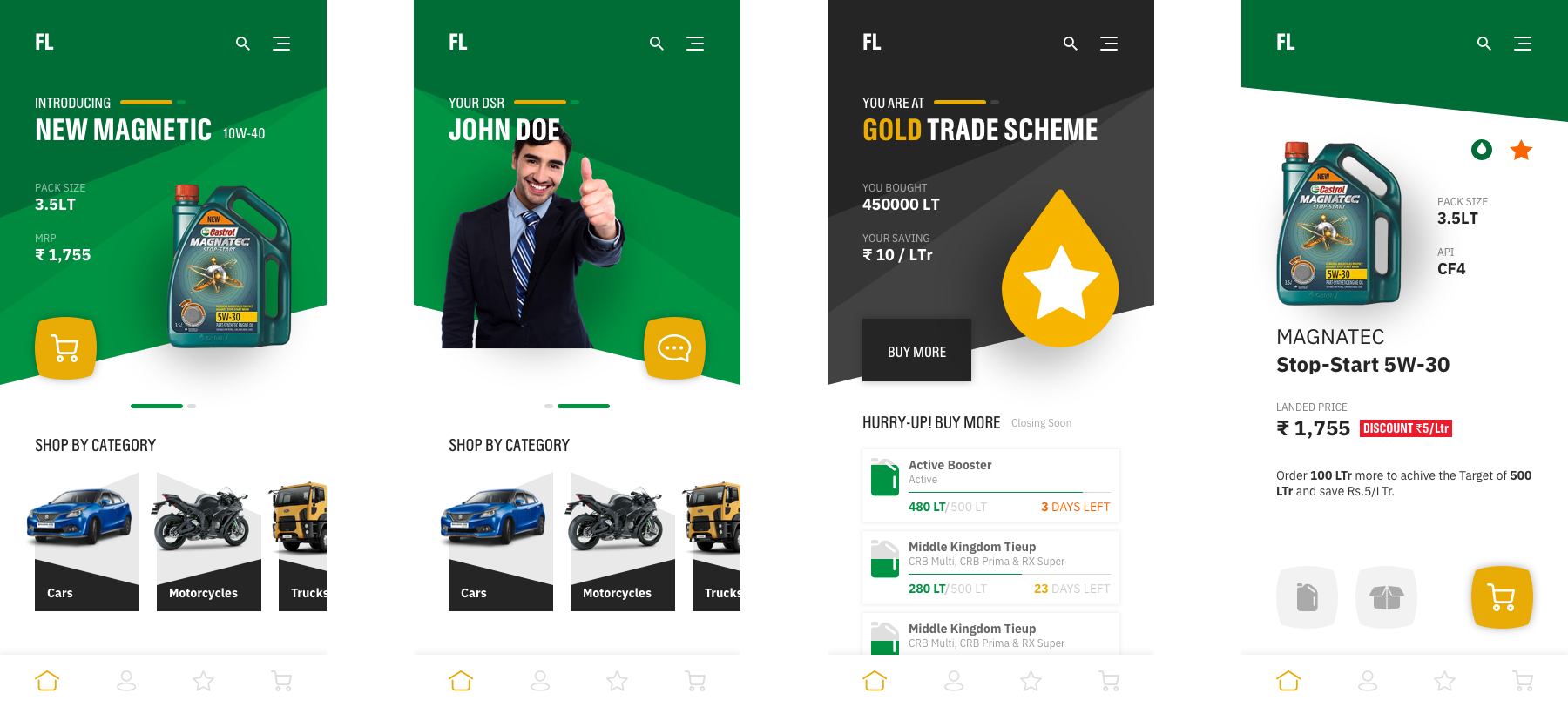
Sample designs from the supplied fastlane.sketch file. Names, prices and figures are illustrative UI content. The file does not establish release status or the relationship of these screens to the workshop prototypes below.
06 / Four directions for further exploration
Translate the friction
into service possibilities.
The workshop generated more than 100 ideas and brought four selected concepts to prototype form. Together, these explored operational confidence, simpler administration, recognition and a closer connection to vehicle owners.
Order-to-delivery visibility
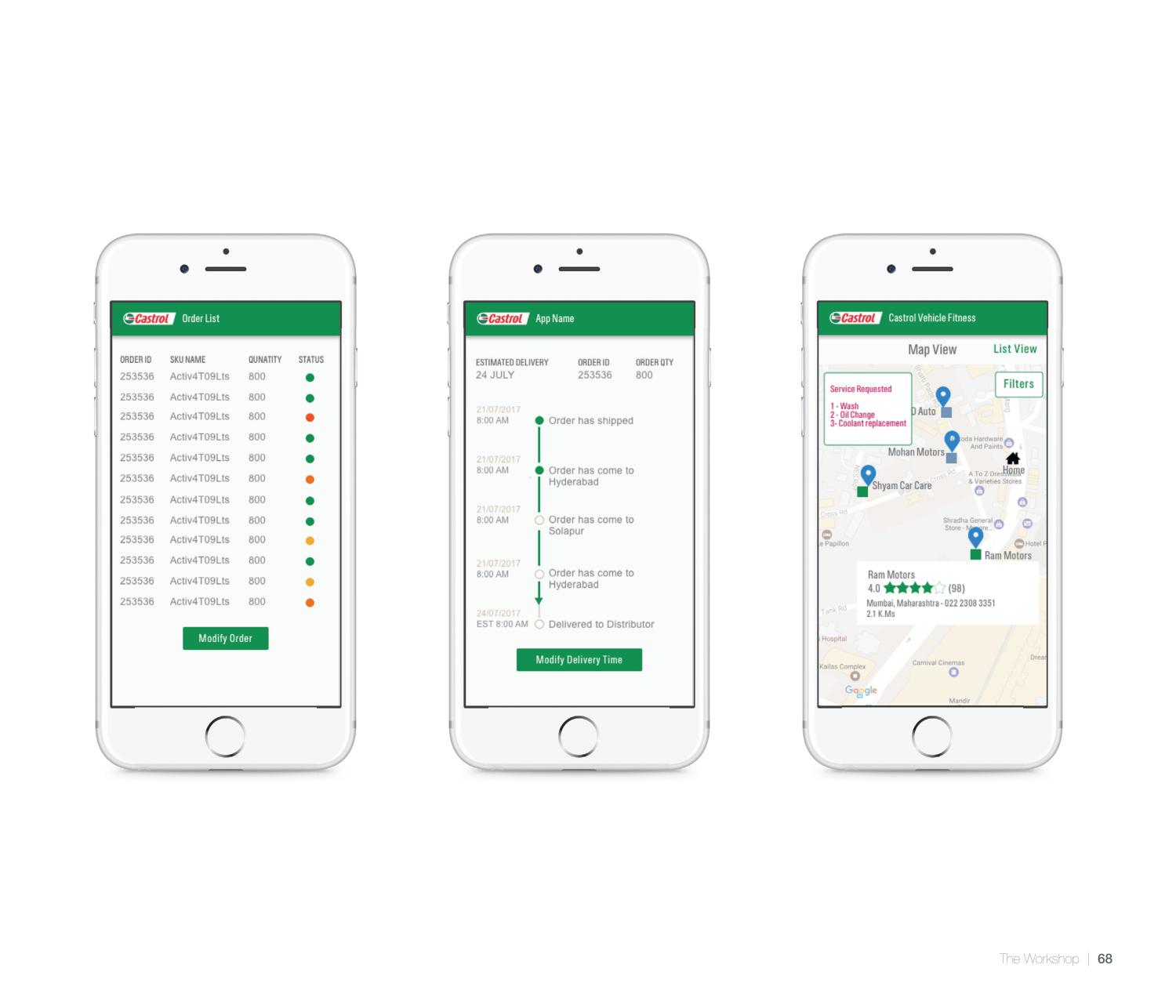
The proposed service gave distributors an order timeline, delivery updates and options to amend orders or delivery times. It also explored visibility into credit and unavailable stock. The intent was to help distributors plan with better information.
Coupons & performance
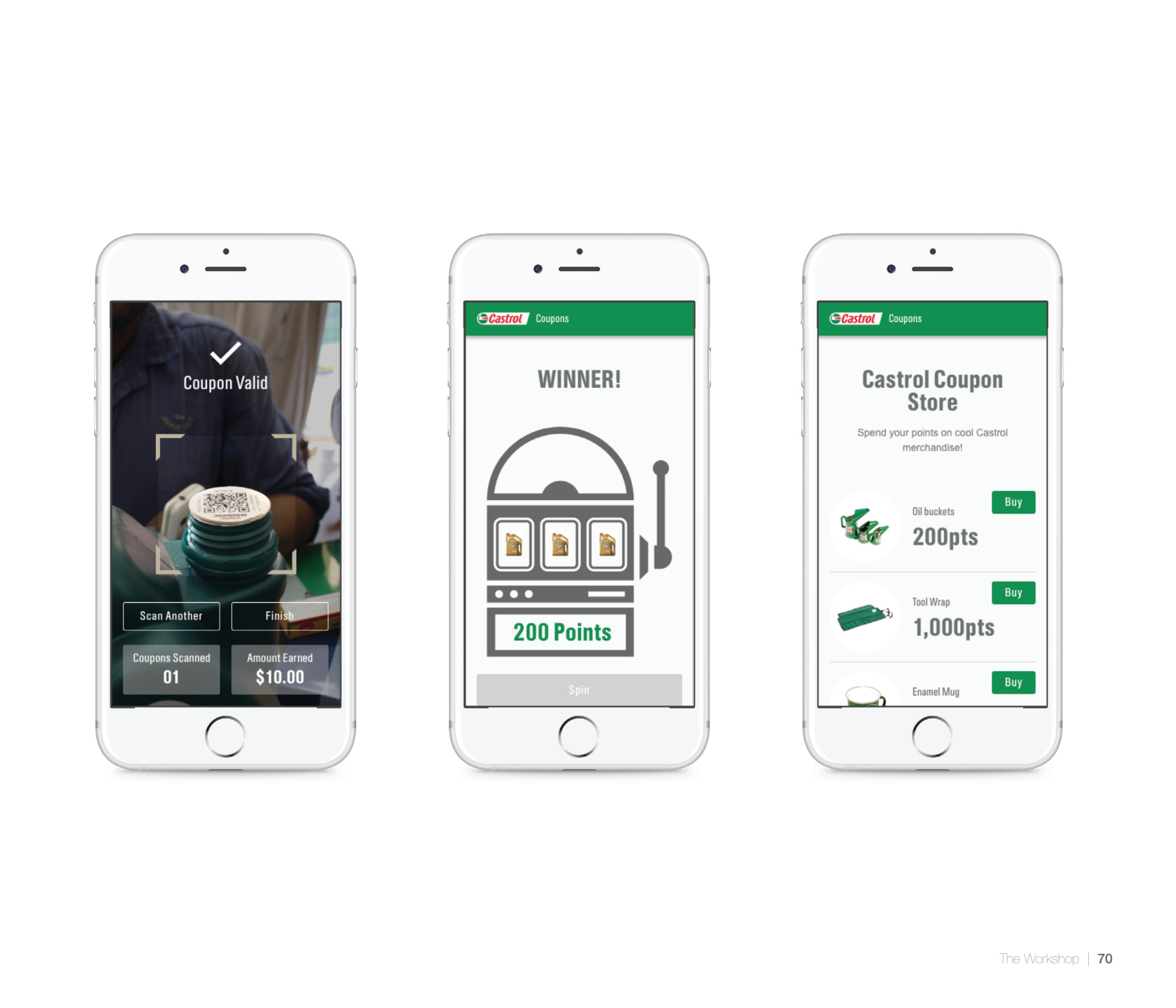
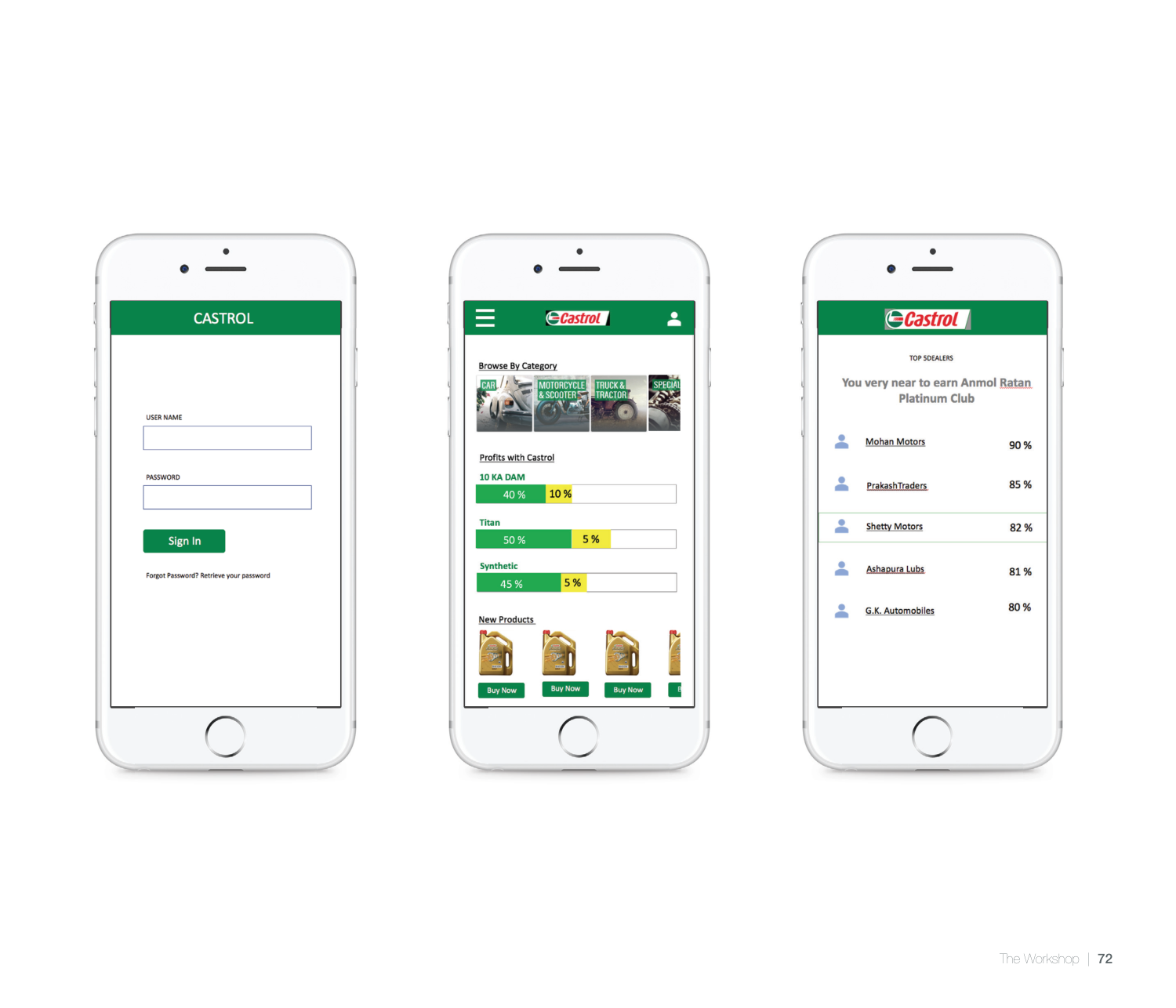
The coupon concept proposed scanning and validating coupons, claiming payments and accumulating points. The performance concept connected targets, product-level progress, schemes and recognition. Both addressed work that partners found cumbersome or difficult to track.
Vehicle fitness
A further concept connected vehicle data to health recommendations, relevant products and service booking. It extended the exploration beyond channel transactions to the vehicle owner’s needs.
Explore the vehicle-fitness prototype
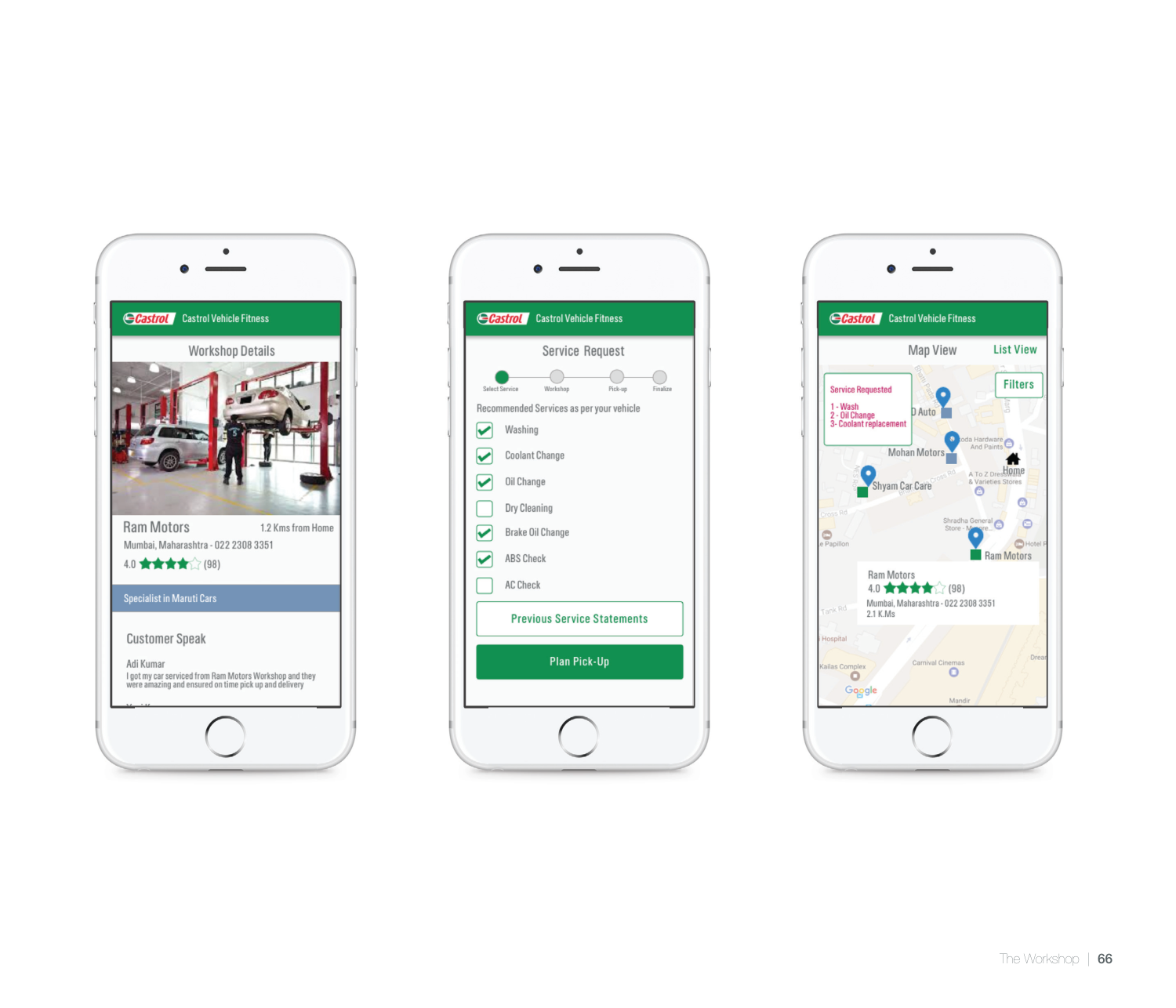 PDF pp. 70–71. The playbook describes an IoT-linked concept; it does not establish a deployed service.
07 / What the workshop established
Shared understanding.
Concrete ideas to take forward.
The documented outputs include refined personas, mapped journeys, prioritised pain points, ideas, storyboards and four prototypes. These gave stakeholders a concrete basis for discussing future services.
The next step would be to validate the concepts with users and assess operational dependencies, feasibility and business value. The playbook does not establish launch, adoption, time savings, loyalty improvement or commercial expansion.
For my portfolio, this case demonstrates a specific facilitation contribution within a broader discovery programme: helping a group work from user context toward tangible possibilities for change.
Source & attribution
- Digital for India workshop playbook, supplied as Case Study.pdf.
- Fastlane sample UI: four artboards represented in the supplied Sketch file’s embedded preview.
- Research and context: PDF pp. 16–41. Workshop scale and facilitator attribution: pp. 42–45.
- Workshop process and journeys: pp. 48–59. Concept descriptions and prototypes: pp. 63–77.
- Numbers describe research and workshop activity, rather than post-launch performance. Rajib is credited as Group 2 facilitator; wider outputs belong to the programme team.